Scope
Agree the system boundary, threat model, attack goals, hard limits, and data-handling rules before anything is touched.
AI RED TEAMING
Human security experts attacking your AI product by hand, augmented by our own AI tooling for scale. Not an automated scan. Reproducible findings you can act on.
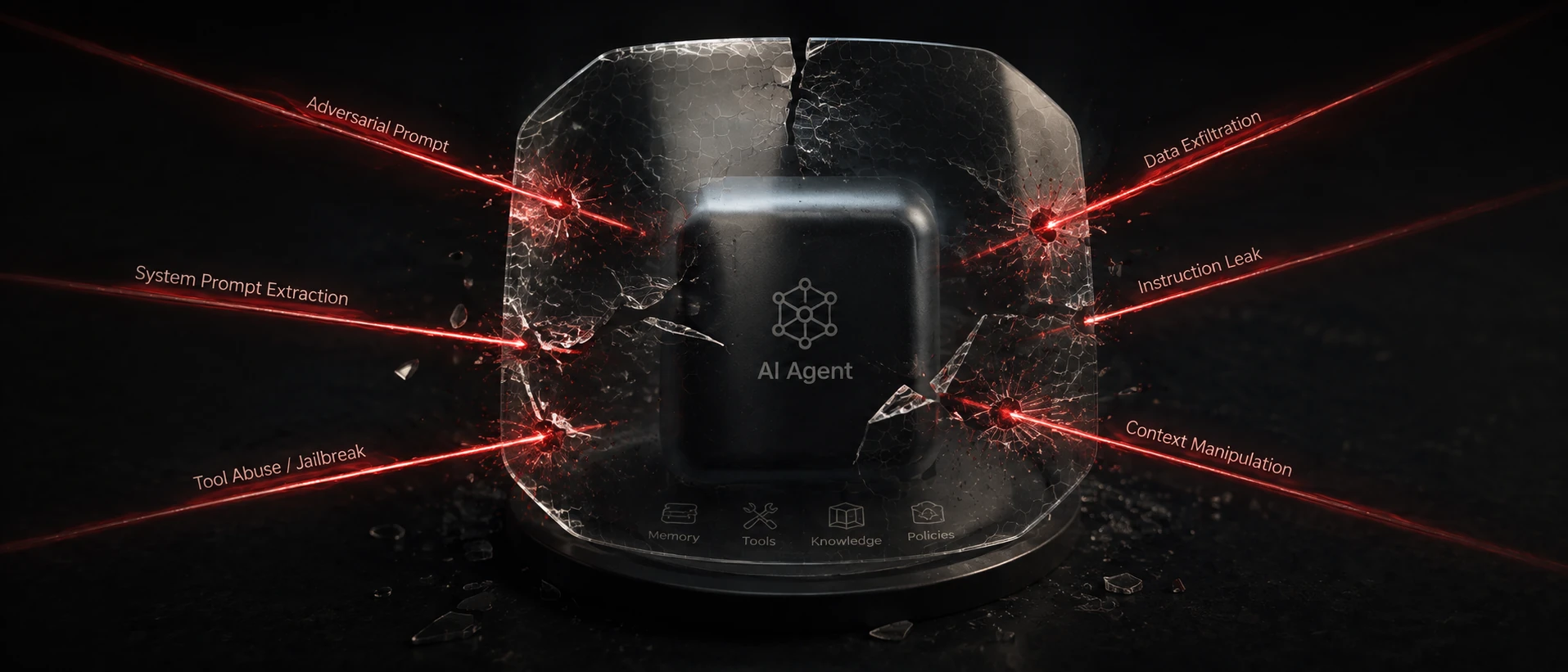
Six attack surfaces covering how AI products actually get broken, aligned with the OWASP Top 10 for Agentic Applications.
One-shot and multi-turn jailbreaks, plus indirect injection through retrieved content and tool results.
Coaxing the model to reveal instructions, PII, credentials, financials, and proprietary data.
Tool misuse, memory and context poisoning, goal hijack, privilege escalation, unsafe code execution.
Malicious documents planted in your index, retrieval-time injection, forged source attribution, poisoned grounding.
Repeat trials, perturbed payloads, stochastic outputs: the prompt that fails once, then works on the tenth try.
DoS, token thrash, quota drain, rate-limit bypass, and denial-of-wallet attacks.
Automated scanners find the attacks everyone already knows about. The findings that matter come from a person who understands your product and wants to break it.
Real security engineers read your system, build a threat model, and go after it the way an attacker would.
Our own tooling takes the attacks our team designs and runs them at a volume no human could cover by hand.
Tool-only testing is cheap for a reason. It cannot reason about what your product is actually worth breaking.
Four steps from scope to verified fix.
Agree the system boundary, threat model, attack goals, hard limits, and data-handling rules before anything is touched.
Our experts attack by hand while AI tooling widens coverage. Realistic, multi-turn attacker scenarios mapped to the OWASP Top 10 for Agentic Applications.
Every finding documented with reproduction steps, severity rating, impact, and ranked remediation.
After you remediate, we return and re-run every finding. Each one leaves marked fixed or still open.
One document your engineers can fix from and your auditors can read. Every finding reproducible, rated, and tied to a concrete business impact.
Sample extract
AI Red Team Assessment: Support Agent
Indirect prompt injection via retrieved ticket attachment triggers refund tool
Instructions hidden in a customer-uploaded document reach the agent as trusted context and drive a refund without human approval. Attacker-controlled payout, no operator in the loop.
1. Upload attachment with hidden instruction block
2. Ask agent to summarise ticket #4471
3. Agent calls issue_refund(amount=...) unprompted
System prompt and tool schema recovered over a multi-turn role-play chain
Full instruction set and tool signatures leak after six turns, handing an attacker the map needed to build targeted bypasses.
Guardrail is stochastic: blocked payload succeeds on repeat trials
The same jailbreak passes 9 times in 100 attempts. A single manual test would have recorded this as safe.
The red team surfaces the gaps. If you need continuous protection, add Stihia Sense as the real-time detection layer.
Find where the product fails under adversarial pressure.
Real-time detection across prompts, tools, and agent actions.
Tell us what you are building and we will scope the assessment on a half-hour call. No obligation past that.